Showing posts with label Public Theater. Show all posts

Friday, August 13, 2010

Looking Back: The Capeman

With the advent of The Capeman as a staged concert presented by The Public Theater and directed by Diane Paulus this weekend, all eyes will be on this re-do of the much belabored, much discussed and considerably controversial musical which played Broadway in 1997-98. 


The Capeman: The Story


Salvador "The Capeman" Agron
at his arrest

The show, with music by Paul Simon and book and lyrics by Simon and Derek Walcott, chronicles the late 1950's real-life tragedy that surrounded both victims and villains when Salvador Agron, aka "The Capeman" because he wore a red and black cape on the streets of New York, fatally stabbed two white teenagers, Robert Young and Anthony Krezinski.  His accomplice, Luis Hernandez, was named "The Umbrella Man" because he used an umbrella during the attack.  It was later fleshed out that the Agron and Hernandez were part of a Puerto Rican street gang, The Vampires (hence the long black cape), and were sent to seek revenge on a rival white street gang.  Instead, they happened upon Young and Krezinski, who were not related to any gang but were in the wrong place at the wrong time.  Agron was sentenced to the electric chair, but was granted a reprieve to life in prison by Gov. Nelson Rockerfeller. Later, he was released, and died of natural causes in 1986.

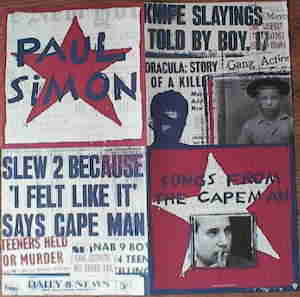
Promotional Art for the Concept Album and the Musical

The Capeman: The Controversy
While Simon, the cast and the creative staff worked on several versions of the show, controversy surrounded it from the outside.  The families of the victims held very public protests, even getting on national televisiob, against the show, claiming it glorified the murderer.  Despite arguments to the contrary - Simon himself publicly stated several times that the show was really about redemption and forgiveness of sin, and that the families (the mothers in particular) of the slain were not given short shrift, but instead played a very large and integral part in the show - protests continued right through opening night.


The Broadway Billing

The Original Cast with Paul Simon (center):
Ruben Blades, Ednita Nazaria and Marc Anthony

Controversy swirled within the show as well.  Paul Simon made very public his condemnation of any and all trappings of opera and the modern stage musical - not a smart move for someone completely new to the Broadway game.  The show itself gestated for nearly a decade before finally being staged.  During the course of its pre-Broadway life and during its previews on Broadway, Eric Simonsom was replaced as director by Mark Morris, the choreographer and now director.  It was no secret that during previews Jerry Zaks and Joey McKneeley were brought in to doctor the show's direction and choreography.  Apparently, it was not enough, as the show, after 59 previews and 68 performances, closed on March 28 at the Marquis Theatre.  The Capeman lost $11 millon, and Simon has not yet returned to writing for the stage.

A complete cast recording was done by DreamWorks Records, but was never released, though eventually it was available at iTunes.  Simon himself recorded several of the songs and released a CD, "Songs from 'The Capeman'".  Some of the songs that stood out from the production included "Can I Forgive Him?", "Esmerelda's Dream" and "Satin Summer Nights."  The score combined salsa, hip-hop, doo-wop and gospel sounds to recreate the Latin flavor and musical styles of the late 1950's.

The Capeman: The Original Cast


Marc Anthony and Ruben Blades in a scene from The Capeman
Marc Anthony: "Satin Summer Nights/Bernadette"

Heading the cast were Marc Anthony (now a famous pop singer and husband to Jennifer Lopez), Oscar-nominated actor and Latin singing sensation Ruben Blades, as Sal Agron at 16 and as an older adult, respectively.  Ednita Nazaria, an accomplished Latin singer in her own right, was Agron's mother.  Renoly Santiago played "The Umbrella Man," and Luba Mason (Jekyll and Hyde, Chicago) and Cass Morgan (Beauty and the Beast, Memphis) played the mothers of the slain teenagers.  A young, future Tony-winner and TV star named Sara Ramirez played Wahzinak, Agron's love-interest.  The 41 member cast included Mark Price (Mary Poppins), Stephen Lee Anderson (Wicked), Natascia Diaz (Seussical, Man of La Mancha), Tony Chiroldes (In the Heights) and Philip Hernandez (Kiss of the SpiderWoman).

The show was nominated for 3 Tony Awards: Best Score, Best Orchestrations and Best Scenic Design.

The Capeman: My Thoughts
I saw The Capeman during one of its final previews, and I rememberr distinctly thinking four things: Marc Anthony is going to be a HUGE star, the scenery (by Bob Crowley) was fascinating, unique and really cool, the show was a hot mess of confusion - the synopsis in the Playbill helped immensely, and most of all, that the audience was incredibly vocal and passionately moved by the piece.  Let me explain.  Marc Anthony was still a relatively new star to Latin music, and hadn't even really broken into standard pop music yet.  His voice was thrilling - organic and sweet - and he had enough charm, sex appeal and charisma to light the Coke sign in Times Square.  Bob Crowley's scenery offered a variety of points of view to get its point across.  The dream sequences were alive with color, and seemed at a distance, perspectively speaking.  The reality sequences were much more austere and offered off angles.  For example, I will never forget the public meeting room at Fishkill prison.  On the floor was a round table with sets that were bolted down and immoveable.  The drop was a series of those same tables - THREE DIMENSIONAL - with people sitting at them.  The perspective?  We, the audience, were the ceiling, looking down on the regimented, dull plain existence that was the prison.  The story, especially in act two, was all over the place - reality, dreams, reality, visual metaphor, more dreams, a series of sung letters (by Ms. Ramirez).  This is what can happen when there are too many chefs and not enough soup.  It seems Zaks only had time to really fix act one, after which I recall very clearly saying to my friend., "what is all the fuss?  This show is good and very together!"  (We still laugh about act two, occasionally!)  Flaws and all, it was a very interesting idea for a musical, just not put together by the right people.

But the audience, largely Hispanic and there to see for themselves just how ugly the show was in representing them, was very quiet at first, but as it went on you could hear people call things out, encouraging young Sal, booing his accomplice, weeping openly as all three mothers sang of destroyed lives and absolution.  Many a prayer was started and finished all around me.  In the end, they roared their approval, and wept and held each other as they walked out.  I have never had such an experience since.

The Capeman: The Future?


Anthony Lee Medina (Young Sal)


Ivan Hernandez (Older Sal)


Original Cast Member Natascia Diaz (right)

The show plays three performances this weekend in Central Park, and features direction by Hair's Diane Paulus and choreography by Jersy Boys/Memphis/next to normal's Sergio Trujillo.  Among the cast of this staged concert are original cast members Natascia Diaz and Luba Mason (who married original star Ruben Blades) and Yank's Ivan Hernandez plays the older Agron.  There is a very interesting article/interview about the genesis of the original show and the perceived future of this revised version with Ms. Mason on Playbill Online - click here.


Diane Paulus and Sergio Trujillo in rehearsal
for The Capeman in Concert


Comments?  Leave one here, email me at Yahoo, Tweet me or Formspring me!
Jeff

Tuesday, July 27, 2010

The Public Theater: Off-Broadway to Broadway, Again and Again

With the announcement yesterday that the Al Pacino-led production of The Merchant of Venice would have a limited run this fall/winter at the Broadhurst Theatre, and the announcement last week confirming that Bloody Bloody Andrew Jackson would be transferring to the Jacobs Theatre for a commercial run, The Public Theater continues a long tradition of bringing its off-Broadway shows to Broadway.  From its downtown theater space to its outdoor Delacorte Theatre in Central Park, a wide variety of plays, musicals, one-man shows and important revivals have made the transfer to the Great White Way.

Top: The Public Theater
Bottom: The Delacorte Theatre
Legendary producer Joseph Papp began what is now known as the Public Theater back in 1955, when he began the New York Shakespeare Festival in Central Park, offering free Shakespeare to New Yorkers for the first time.  Later, he created New York's first travelling theater.  Among the Public Theatre's many achievements, it was also among the very first professional theatres to employ "color blind casting," with no less than James Earl Jones appearing in The Cherry Orchard.  What today is common practice and rarely even noticed, was quite avante garde and controversial.  The Public Theater still operates the Delacorte Theatre in Central Park, along with it's flagship space, the former Astor Public Library.


Coming This Season: The Merchant of Venice and
Bloody Bloody Andrew Jackson
Some facts:
  • The Public Theater has been awarded 42 Tonys, 40 Drama Desks and 4 Pulitzer Prizes among many awards.
  • It won the Special Tony Award 3 times: 1958, 1970 and 1984, when A Chorus Line became the longest-running show in Broadway history.
  • The Drama Desk Awards presented the company a special achievement award in 2005, in honor of its 50th anniversary.

A book about the man who started it all:
Joseph Papp

23 of its plays, musicals, revivals and one-person shows were either nominated and/or won the Tony for Best in the Category.  The winners were:
  • 1972: Best Play, Sticks and Bones
  • 1972: Best Musical: Two Gentlemen of Verona
  • 1973: Best Play, That Championship Season
  • 1976: Best Musical, A Chorus Line
1976 
  • 1981: Best Reproduction of a Musical: The Pirates of Penzance
  • 1986: Best Musical: The Mystery of Edwin Drood
  • 1993: Best Play: Angels in America: Millennium Approaches
  • 1994: Best Play: Angels in America: Perestroika
  • 2002: Best Theatrical Event: Elaine Stritch: At Liberty!
  • 2003: Best Play: Take Me Out
  • 2009: Best Revival: Hair
1986
Some of its most notable productions also include: The Normal Heart, The Threepenny Opera (Raul Julia), The Colored Museum, Hamlet (Kevin Kline), For Colored Girls Who Have Considered Suicide/When the Rainbow is Enuf, Bring on 'Da Noise/Bring on 'Da Funk, The Wild Party, Runaways, Topdog/Underdog, and Caroline, or Change.

With these two new critically acclaimed shows, that award-winning tradition is bound to continue!


Comments: Leave one here or email me at jkstheatrescene@yahoo.com.
Questions: Ask me anything at http://www.formspring.me/. Look under "jkstheatrescene" or "Jeff Kyler."
Jeff